From Suburbs to Shisanyamas: The Surprising Story of the Kettle Braai
Picture this: It’s the 1950s in suburban Chicago. A metalworker named George is staring at a floating ocean buoy and thinking, “This could cook a mean steak.”
Sounds bizarre? It is. But it’s also the true origin story of the kettle braai—an invention that travelled 13,000 km and somehow became more at home in a Joburg backyard than in its American birthplace.
So how did this round, lidded contraption become a South African staple?
Let’s lift the lid.
Where the Kettle Braai Came From (And Why It Had a Lid in the First Place)
The kettle braai was born in the United States in 1952 when George Stephen, a welder at Weber Brothers Metal Works, cut a buoy in half, added a lid, and punched in air vents.[1]
Why? Because the open braais of the day were unreliable. Wind blew ashes everywhere. Flames flared. Steaks burned outside and stayed raw in the middle.
The lid? That was the game-changer.
It turned braaing from fire-taming chaos into a more refined (yet still proudly primal) experience.
In short: It gave the fire focus. And flavour.
How It Found Its Way into South African Yards and Lapa Corners
Fast forward a few decades, and Weber was exporting globally. But in South Africa, something clicked deeper.
Here, where braai is more than cooking—it’s identity, gathering, ritual—the kettle braai wasn’t just another product. It became a kind of status symbol.
It said:
- “I braai more than boerie.”
- “I know how to use air vents.”
- “I can roast a chicken without a rotisserie, and it’ll be perfect.”
Soon, the kettle braai was popping up in Cape Town courtyards, Pretoria patios, and even in the boot of the bakkie on camping trips.
Because while it started as an American idea, it got adopted the way we do best: with fire, family, and flair.
What Makes It Different from a Normal Braai?
Besides the obvious (the lid), the kettle braai gives you two major advantages:
- Temperature Control
Airflow vents and a built-in thermometer let you manage heat like a braai whisperer. - Indirect Cooking
You can cook meat next to the coals, not directly over them.
That means:
– Juicier chicken
– Better ribs
– Smokier flavour without the drama
Bonus? Features like warming racks and ash catchers make the whole experience smoother—like your cousin’s Hilux but with more flavour.
The RS Way: Braais That Actually Respect the Flame
Our MagMaster Kettle Braais weren’t built to blend in. They were made to roll out—with mag wheels, hinged lids, warming racks, ash catchers, and built-in thermometers that finally let you stop guessing.
We even throw in a fitted cover.
Because real heroes?
They cape up.
This isn’t your average “melamine and wobbly wheel” special. This is Outdoor Buddy—firepower that moves, heats, and lasts like it means it.
Ready to Roll Out Like a Legend?
Shop the MagMaster 57cm Kettle Braai – with hinged lid, warming rack, and thermometer. For the flame-tamers and chop-lovers alike.
Want something bigger? The MagMaster 70cm Barrel Braai brings bakkie vibes and backyard dominance.
-
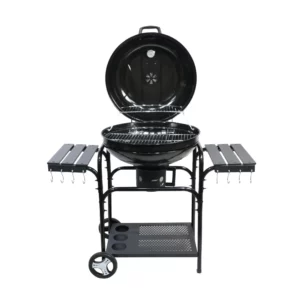
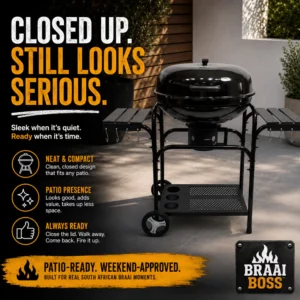
BraaiBoss 57cm Premium Charcoal Kettle Braai with Side Shelves & Thermometer
R1 990 – R2 780Price range: R1 990 through R2 780 inc VAT Add to Cart This product has multiple variants. The options may be chosen on the product page-
- Brand New
- Seconds
- Warehouse Collect
- Clear
-